Cool Drawings of Old Trucks
While simply about every machine geek is familiar with classic pickups like the '40 Ford, Series 1 and ii Chevys, and mayhap even more than unique 4x4s by Marmon-Herrington (mostly for Ford) and Napco (mostly for Chevy and GMC), chances are many are unaware of the niche orphans and forgotten variants on this list. So allow's take a moment to celebrate and consider these lesser-known design classics.
Each truck listed here is special in its ain fashion, merely all of them have the aforementioned purposeful utility that we still value today—enough so to maybe fifty-fifty make yous pry open your wallet and detect some room in your garage. They are presented in no item society, just I assure you that at least i or 2 volition get stuck in your brain. And to be articulate, that is exactly my intention: to non just expand your noesis, only to sway y'all into buying a vintage truck. I feel no guilt about this mission. Go get 1!
1937-1939 Studebaker Coupe Express J5
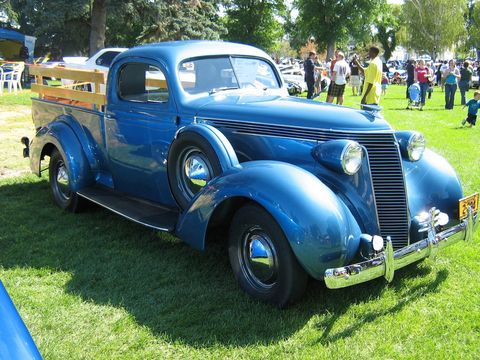
Studebaker fabricated commercial vehicles starting in 1914 up through 1964. Going commercial was a logical pace for Studebaker back then, as it was already highly regarded for its horse carriages and had a loyal customer base in subcontract and industrial communities across the nation. For me, this J5 Coupe Limited model, with its perfect art-deco lines flowing uninterrupted from stem to stern, is the coolest lite-duty Studebaker truck of them all. The more streamlined design was due to Studebaker developing this pickup off of the pop Dictator passenger car series. Consider this the forefather of the Ranchero and other car-based pickups that came on the scene some 20 years later.
The Express initially saw limited sales compared to the cheaper Ford and Chevy models of the era (priced some fifteen percent higher than the boilerplate), with about 3500 full examples built in Due south Bend, Indiana (3125 units) and in Vernon, California (375 units). At that place were fifty-fifty a few "woodie wagon" versions offered in the earliest days of production. Not only were these piddling trucks stylish, merely they also featured many nifty features non found on other rival contemporary trucks, such every bit wing windows (seriously important in the days earlier A/C), a double-walled bed, a loma holder, and an overdrive transmission.
Neat trivia: The front end and rear fenders are interchangeable!
1937-42 Willys
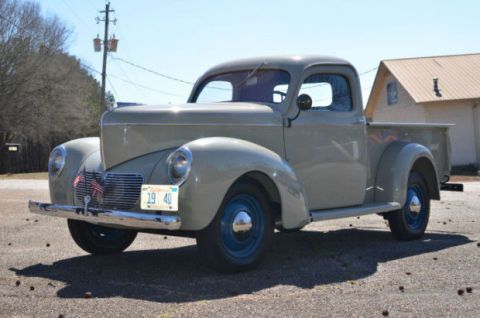
When most truck people hear Willys or Willys-Overland, they think of the "jeep-like" Willys models made from 1946 to 1965. Every bit part of a brilliant marketing move to continue its relationship with returning servicemen after the state of war, Willys adult wagons, pickups, and even a convertible (the Jeepster) based on their wartime CJ Series. However, near people do not know nigh this odd little truck. There were also sedan, station wagon, and coupe versions (the coupe was favored by hot-rodders forever), but the pickup is noteworthy for its simplicity and proportions. The cab is quite modest, and there were most no options or frills, including ornamental trim details. The Willys mission here—other than simply to try and stay in business subsequently their latest bankruptcy and reorganization—was to evangelize a low-cost vehicle. Starting at $589, this truck was just that.
The '37 and '38 models are virtually identical while the '39 models featured a smashing shark-olfactory organ front end finish, which was once again redesigned in 1940. The '41 was quite like, simply it was distinguishable in that the front grille was now a one-piece affair. In 1942, Willys added a vertical chrome detail to the grille design. The 1940 model is the most popular, but my option would exist a '39.
All of these versions were designed by innovative automotive designer Amos Northup, who also did blueprint work for Graham, REO, Hupmobile, and American Austin. He is credited with being the get-go automotive designer to integrate more than uniform, enclosed fenders, and for being the first to move the radiator cap under the hood.
Nifty trivia: At the time, Willys vehicles were the lightest rider vehicles on the market and had the narrowest rails width.
1956-1957 Willys FC-150
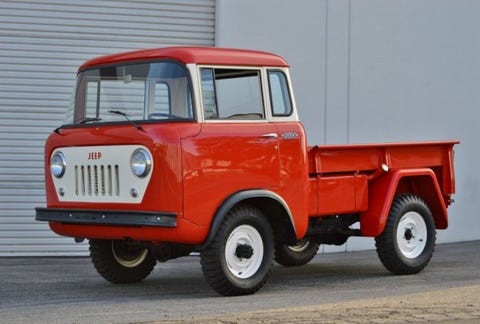
I couldn't allow myself to mention the Willys above without besides paying tribute to this little freak, the FC-150, introduced in 1956. There's a proficient gamble many of y'all accept seen this one past at present since Jeep has teased mod versions as office of its brilliant Easter Safari Concepts, but it still deserves to go on this listing. Just look at it.
At the time of the original, many of the Willys vehicles were one-time designs dating dorsum to the late 40s, and company brass wisely hired rockstar designer Brooks Stevens to breathe some new life into the make. The FC (Forward Control) took inspiration from larger cab-forwards trucks to imply brute utility, and it was predominately marketed to municipalities and commercial clients. It was offered by the factory equally a pickup, but many "Jeep Approved" body kits were available, such as dump trucks and tow trucks. The FC had an unmatched approach bending and proved to be quite capable. One could argue that these were the designs from which the modernistic minivan was born.
Neat trivia: Folklore was that they could float. I don't know if it's true, only I once saw a vintage photo of some intrepid duck hunters who fastened some side floats to ane to get to where they were going.
1937-1947 Hudson Big Male child C28
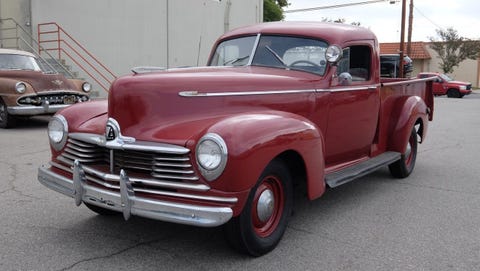
The earliest Hudson trucks were used by the dealerships and sometimes as local fire trucks and ambulances as early as 1914. Near were built by 2nd parties or the dealers themselves. The starting time in-business firm pickup came in 1929. Originally the trucks were branded Dover when they were based on the Essex car chassis, but the name switched to Terraplane from 1934 to 1938. Hudson made its biggest commitment to commercial vehicles and pickups in 1939 with iii wheelbases and several trim levels on offering.
The before Terraplane pickup is neat in its ain correct, only it all the same kind of looked similar an adapted coupe. My personal favorite is the C28 made from 1939 to 1942 and again from 1945 to 1947 later the state of war. They are commonly referred to as a "Big Boy," but that name was officially designated for the three-quarter ton version and excluded the half-ton. The Big Boy is nigh the size of a modernistic pickup, with a 128-inch wheelbase and a huge bed measuring 4'9" x 7'ix".
Hudson made a smart move when contemplating this design. Information technology realized that it did not have the resource to compete with the Large Three in the economy truck market, so, instead, information technology decided to create the admirer'due south pickup and crafted this model based on the big Hudson Commodore sedan. The end effect is a utilitarian sculpture that had such fluid lines you could appreciate it without always even thinking of its passenger automobile sister. It looks more like something skillfully customized—chopped, channeled, and Frenched—than a production model.
The styling was not the only benefit gained from using the rider-car design. Mechanically, these trucks were quite avant-garde, with a big direct-six, column-shift manual (when almost every other truck was still on the flooring), independent forepart pause with sway bar, and other quality details.
In addition to the pickup, Hudson too offered a sedan delivery version, although I have never seen one. In 1948, the company switched to a unibody blueprint, and then the whole commercial line was scrapped. I personally just bought a '46 a few weeks ago and cannot await to get started on the resto!
Not bad trivia: Perhaps the graceful blueprint details on this truck could be due to the female perspective. The nuance and much of the trim on this model was designed by America's first woman designer, Betty Thatcher Oro.
1957-1959 Dodge Sweptside
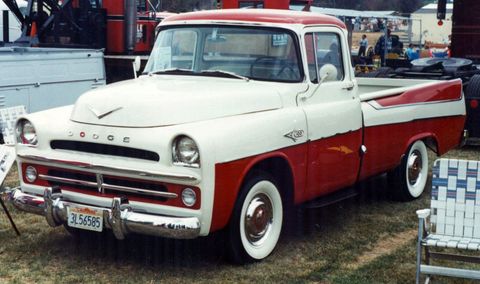
The so-ugly-information technology-is-beautiful Sweptside was offered from 1957 to 1959 as Dodge's respond to the Chevrolet Cameo, the Ford Ranchero, and ultimately, the flashy tastes of the American public at the fourth dimension. Back then, Contrivance had a special division chosen the Special Equipment Group, which was more often than not tasked with configuring the commercial vehicles to the specific needs of fleet buyers. This project was assigned to the SEG team considering the project had lilliputian to no budget and Virgil Exner'due south Advanced Styling Studio at Chrysler was slammed.
The crafty SEG crew, led past Joe Berr, knocked it out in a hurry, by and large by raiding the parts bins from other models. They started with a standard long-bed custom cab, grafted on rear quarter panels and a back bumper from the ii-door station wagon, and then hung on every shiny trim slice they could become their hands on . . . Voila! Dodge rushed it to market in late 1957, but the Sweptside didn't sell well and never even made information technology to the production line. Well-nigh units built were fully loaded, with a V8, automatic manual, flashy 2-tone pigment, and more. They were as well built by hand, a costly endeavour. Merely near 1200 were ever made, and they are quite difficult to find. If institute, they are even harder to restore due to the many unique parts and their hand-crafted bodies.
Neat trivia: It's said that ninety percent of these were painted red and white.
1949-1951 Tempo Matador
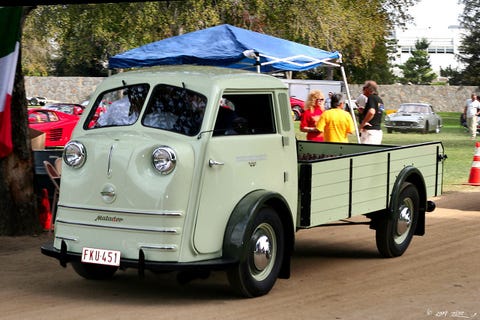
Here we have the forepart-wheel-drive Matador. Beauty is in the eye of the beholder, equally they say, so you lot'd be forgiven for thinking that a pug designed this vehicle. In fact, these trucks were built past Vidal Sohne in Hamburg, Germany, from 1949 to1951. They were available equally passenger or cargo vans and pickups. Despite their measly 25-hp motors sourced from Volkswagen, they were famous for their ability to haul huge loads.
Unfortunately, VW started evolution of its own competing vehicle, so information technology stopped supplying engines to Tempo. This forced a complete redesign to the Tempo, which now had to run an Austin engine and required many design changes. I discover the newer versions to lack the funky charm and quirky looks of the earlier Matadors. Sohne only produced almost 1200 of these vehicles, only they have quite the cult following. I've seen a few at shows over the years, and I think this could make a peachy EV resto-mod. Hmmm . . .
Great trivia: For some reason, these became a huge success in Uruguay. There are several clubs defended to the truck to this twenty-four hour period.
1952 Mercedes-Benz 170
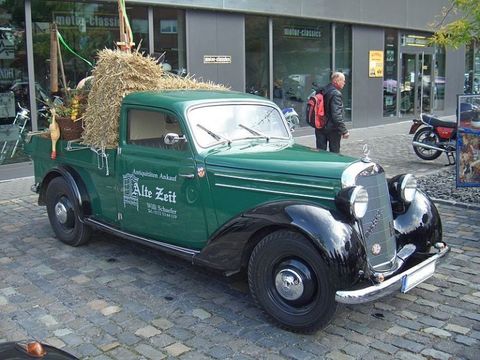
Afterward the cease of WWII, Mercedes struggled to restart industry. Virtually of its plants had been bombed, and a few of its key suppliers were at present in Russia-occupied East Germany. The company had to get crafty. So information technology restarted product of the 170 model in 1946 more often than not by patching together pre-war tooling that dated back to 1936. To accost the immediate needs of post-state of war Germany, all 214 units produced that beginning twelvemonth were pickups and sedan deliveries. Given the limited resources at the time—no coal, no, steel, and even no power much of the time—the lines of these trucks are remarkably make clean.
The 170 is a rare site in the U.Due south., but at that place are examples all over the residuum of the globe, equally they were often built nether license contracts. While Americans practise not always call back of Mercedes when discussing pickup trucks, the company has a deep and long history of building quality utility vehicles. Pickup variants of Mercedes vehicles were offered up until the late 1960s. Classy hot rod project anyone?
Swell trivia: If you tried to go likewise fast, these trucks were notorious for dumping their load out the back and and going into a curl due to the antiquated rider-car intermission. And then go along information technology slow if y'all haul in one of these.
1947-1955 Nash "Booty Thrift"
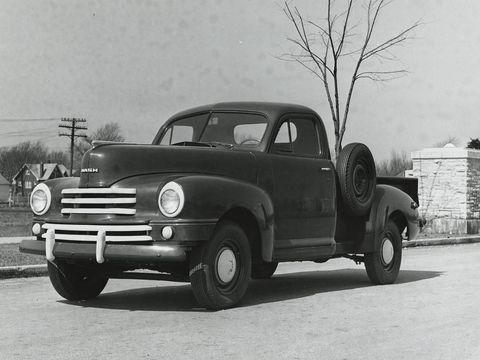
Betcha didn't know Nash had a pickup! Well, for awhile, dorsum in the early 20th century, Nash was the world'due south largest volume truck manufacturer, with eleven,490 units made in 1918 lonely. Information technology closed its commercial division in 1931 to focus on cars, but from 1947 to 1955 it did produce a few thousand "Haul-Thrift" trucks based on a iii-ton chassis and the sheetmetal from their 600 series/Ambassador passenger car. Most were wreckers, and officially they were for consign but. Apparently that dominion was non strictly enforced, because many of their dealers ended up with them, using them every bit parts runners and tow trucks at the dealerships. Odder still, several half-ton and 3-quarter ton versions have been accounted for also.
Nash never officially offered the Booty Thrift, but at that place are vintage manufactory photographs of several versions, and such an effort would not have been made unless the visitor had some sort of grand programme. In that location are also published media stories in 1946 about Nash's intention to brand pickups again. Merely after merging with Hudson in 1954, all mill archival information was lost. So despite my wealth of automotive celebrated knowledge and ample research effort, this one remains a chip of a mystery.
Peachy trivia: I have seen a few of the larger Booty Thrift versions come up for sale, and they are surprisingly cheap. That model, every bit well equally the smaller versions, had super-cool automobile-turned approximate panels.
Jonathan Ward is the founder of Icon Customs and an avid motorcar geek. As a Route & Rails contributor, his monthly column, Ward'south World, covers all matters of pattern and automotive miscellany.
This content is created and maintained past a third party, and imported onto this page to help users provide their electronic mail addresses. Yous may be able to find more than information about this and similar content at piano.io
Source: https://www.roadandtrack.com/car-culture/car-design/news/a29742/eight-cool-pickups/
0 Response to "Cool Drawings of Old Trucks"
Enregistrer un commentaire