Robert B Townsend American Academy of Arts and Sciences
Readers open Perspectives on History expecting to observe Robert Townsend's comprehensive and agile presentations of information-all sorts of data, only most oftentimes relating to the employment of historians. If he is truly on his game in any given calendar month there will be pie charts. Otherwise we settle for the less elegant bar graph, or peradventure a gracious curve or two illustrating a trend. Regardless of the medium, we learn. We learn about the vicissitudes of the academic job market place for historians; the ups and downs of enrollments in history courses; and the trends in advanced degrees.
Not this fourth dimension. This month Robert Townsend the historian, author of History's Boom-boom: Scholarship, Professionalization, and the Historical Enterprise in the United States, narrates the AHA's journeying toward the digital age, and the many bumps along the way. It is time for this story, because after 24 years at the AHA, Townsend is moving to the American University of Arts and Sciences where he will direct a new Washington office and oversee the Humanities Indicators project. He entered the AHA equally an intern; he leaves as deputy director.
Townsend is also the correct person to tell this story. He played a fundamental role in shepherding the AHA's publishing programme into the digital historic period, nudging the Association toward a publishing model that wed traditional impress publications with an assortment of social media spaces, allowing multiple generations of historians to contribute to a single chat across media platforms. He helped diversify the AHA'due south engagement with the many professions that plant our discipline, and facilitated what is today a thriving online community of historians. For that, too as the pie charts and bar graphs, we are all grateful.
-James Grossman
It is easy to talk well-nigh a revolution; it'south rather more hard to negotiate through one. When I started at the AHA in 1989, our publishing programme consisted of three serial publications and a few dozen brusk monographs and study aids. For all practical purposes, it differed in size, only not in substance, from the Association's publication program of a full century earlier. While I was hired because I had some experience with databases and could employ a PC-ane of the first purchased by the AHA-my task was to help get ink on paper.
As I leave the Association, the program seems fundamentally changed. While print publications still retain a central place, they are increasingly merely 1 part of a much broader communications program for reaching members and a much wider public. More importantly, we now call back in terms of a broad spectrum of interactions that go well beyond our membership. But it has not been a elementary or easy journey, and we have discovered on more one occasion that it is quite like shooting fish in a barrel to extend by our audience.
My earliest attraction to electronic media flowed from the thought that the technology could open new ways of telling history, and the AHA staff moved quickly to embrace the early on promise of the web. Guided by Roy Rosenzweig at the Centre for History and New Media, the AHA set up up a spider web presence in fall 1994 comprised largely of content fromPerspectives on History. Withal, despite my earnest-and quite naïve-insistence that the print version of the AHA'south flagship scholarly periodical, American Historical Review, would shortly disappear, it was about five years before the AHA took the next hesitant steps toward that vision.
Anticipating that the online environment would facilitate new kinds of scholarship-scholarship that was fundamentally transformed by the medium and open to new kinds of arguments and interplay between analysis and show-the AHA finally partnered with a number of other organizations to create two new types of facilities for online publication. In 1999, working with the University of Illinois Press, National Academies Printing, and Periodical of American History, we helped found and underwrite the History Cooperative, an online platform for history journals. Effectually the same time, we also partnered with Columbia Academy Press and Columbia's libraries nether a grant from the Andrew Due west. Mellon Foundation to create the Gutenberg-due east project, an innovative effort to convert dissertations into online scholarly monographs.
In my memory, both projects were amidst the most heady and innovative I had the pleasance of working on at the AHA. And for a time, others in the humanities looked to these projects as models at the cut edge. Ultimately, however, we discovered two rather serious issues-coin and support from the field.
In hindsight, we rushed too far alee of both the bailiwick and the bachelor technologies. While trying to maintain a low subscription charge per unit for both institutions and members, we could non pour sufficient funds into the projects to sustain them in the face up of rapid technological change. And among our members, we struggled to secure authors who were interested in really doing something new and innovative with the medium.
In a survey of members I conducted in 2010, I plant that while virtually 73 percent of academic historians were actively using new technologies in their work, most still saw history primarily equally a medium of words, and hence of the printed folio.i That, I am afraid, is where nosotros still stand up insofar as innovation in the area of scholarship is concerned, and quite frankly the feel fabricated me rather wary about getting too far ahead of the curve once again.
And I am sad to say that part of our financial challenges seemed to ascend from our experiments with open access, as the AHA has yet to detect a happy balance between our acquirement needs and our desire to accomplish the widest possible audience. Over the past 15 years, the Clan experimented with a number of different types of open access in an effort to find that balance.In 1997, we revised all of the AHRwriter contracts to permit authors to post a copy of their article on a personal website or institutional repository, known as "self-archiving," only merely a handful of authors (generally aligned with the digital humanities) took up the offer. Then, as we kicked off the History Cooperative in 1999, we fabricated the issues completely open up online. Unfortunately, institutional subscriptions cruel 8.five percent during the kickoff twelvemonth of the experiment (fig. 1).
| Figure 1:AHRInstitutional Subscriptions (Print and Online), 1990 to 2010 |
 |
To some extent, the subscription drib could be attributed to the journal's availability on JSTOR. But the decline during the twelvemonth of open access was notable as the largest almanac drib in the time we'd kept records, and then the Clan closed access again to all but members and subscribers. In 2005, the AHA Council decided to experiment with a different form of open access-making all articles open immediately upon publication, but keeping the book reviews (which tend to agree the most immediate interest for readers) closed.
We quickly discovered that libraries did not share our sense of priorities about the journal's content, as institutional subscriptions dropped again, and library buyers freely cited the open up availability of the articles as the reason for dropping their subscriptions. Subsequently another decline of almost eighteen percent in subscriptions, and as evidence arose that the audience for the manufactures was fairly limited (virtually readers left mere seconds after landing on an article), the AHA Council walked back a flake from the open access policy-commencement by adding a one-year gate to the articles, so by shifting to a three-year moving wall. That decision again stabilized our subscription sales. We too revised the author agreements, and currently provide a toll-complimentary link to the published articles that the writer may post on their websites or in an institutional repository.
I recognize that many people view the emptying of print as key to solving many of the toll impediments to open admission, but I have found very little interest in an east-only option among dues-paying members. In our internal surveys, and a separate survey of members of the National Council on Public History, well over lxxx percent wanted the impress version to provide their initial reading feel for the periodical.ii Surprisingly, information technology seems there is very lilliputian difference between the age cohorts on this question. The technology has changed some behavior. Most members seemed perfectly willing to dispense with print after their initial reading, and rely on the digital version every bit an annal, just the impress and digital forms are clearly serving two unlike needs-2 needs history organizations ignore at their own peril.
Every bit a issue of by challenges, the AHA is moving more cautiously into the area of online scholarship, and is focused instead on engaging members and others more generally interested in history. We accept been posting content fromPerspectives on History since 1995 (mostly ungated). In 2006, we started the AHA Today blog, and followed that over the past five years with spaces on LinkedIn, Facebook, and Twitter.
The print publications all the same serve as the centerpiece the communication program-feeding content online and setting up a variety of conversations across a range of social media sites-but recently, original content on the website and blog take begun to feed content back into our print publications.
As part of this change, the organization had to accept a significant internal cultural shift. When I first took over as "editor" ofPerspectives in 1992, my role was nominal-largely limited to placing text on the folio. That narrow view of communication is no longer viable. Being fully engaged and agile in a social media environment ways relationships with a wider array of interests, occurring at a much faster pace, and in a infinite where information is often fleeting. And the AHA has changed to meet that challenge, by assuasive staff of varying degrees of professional expertise to participate in discussions and serve as content creators who tin accost the many unlike audiences of the Association.
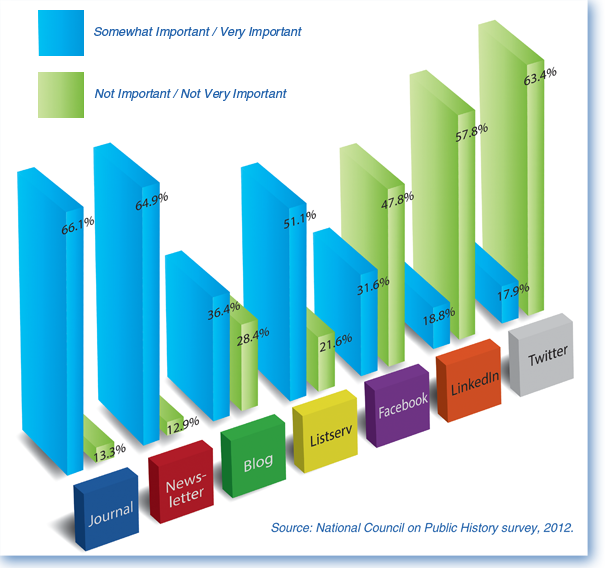
As a recent NCPH survey shows, historians draw from a wide assortment of information sources (fig. two). Looking ahead, the AHA is working to develop new spaces inside the AHA website that will let members to create content and participate in scholarly and professional exchanges-with their peers or the world at big. Some indication of this new mission is evident in the recent teaching initiative described by Patty Composition ("Tipping Points in Teaching: A Call for Collaboration,"Perspectives, Dec 2012). Merely it volition conspicuously take more time before the discipline's conception of scholarship-both its form and how to assess its value-realigns to fit with the irresolute patterns of communication.
| Figure 2: Perceived Value of Data Sources Co-ordinate to Public Historians |
 |
Whether it has been revolution or evolution, at the end of my 24 years, the AHA's publishing and communications program has fundamentally transformed. Many of my friends in the Twitterverse and blogosphere are quick to suggest that it hasn't changed enough, while many of the AHA'due south traditional members maintain it has inverse besides much. As I shift from directing these efforts to a new role every bit an AHA member and online participant, I expect frontwards to seeing where the Clan goes from hither.-Robert Townsend, former deputy director of the AHA, is director of the Washington office of the American Academy of Arts and Sciences.An earlier version of this newspaper was presented at a panel on "Scholarly Societies in the Humanities: New Models and Innovation," sponsored by the Scholarly Advice Program and the Digital Humanities Center at Columbia University.
Notes
1. Robert B. Townsend, "How Is New Media Reshaping the Work of Historians?" Perspectives on History(November 2010).
2. The findings from the survey of NCPH members tin can be found at Robert B. Townsend, "Speaking of the Survey (Office 3): Diversity and Claiming in Public History's Data Mural,"History@Work.
Source: https://www.historians.org/publications-and-directories/perspectives-on-history/may-2013/from-publishing-to-communication
0 Response to "Robert B Townsend American Academy of Arts and Sciences"
Enregistrer un commentaire