What Popular Art Pieces Are in Notre Dame Cathedral
On 15th Apr, the world watched in astonishment and horror every bit i of Paris'southward about celebrated historic landmarks was engulfed in flames, causing the main structure of the twelfth-century cathedral to eventually plummet. Notre Matriarch (pregnant 'Our Lady') is approximately 850 years and is much loved for its French Gothic architectural style and for its beautiful stained glass windows, known as the 'Rose Windows'.
More than than merely a religious building, the cathedral has always had a profound cultural and symbolic impact on artists and literary figures alike, from Victor Hugo to Henri Matisse and Marcel Proust. And of course, it was the abode to our favourite bell-ringer – Quasimodo.
To celebrate the celebrated cathedral that has survived centuries of turbulent history including multiple revolutions and 2 World Wars, here is a option of artistic depictions on Art UK.
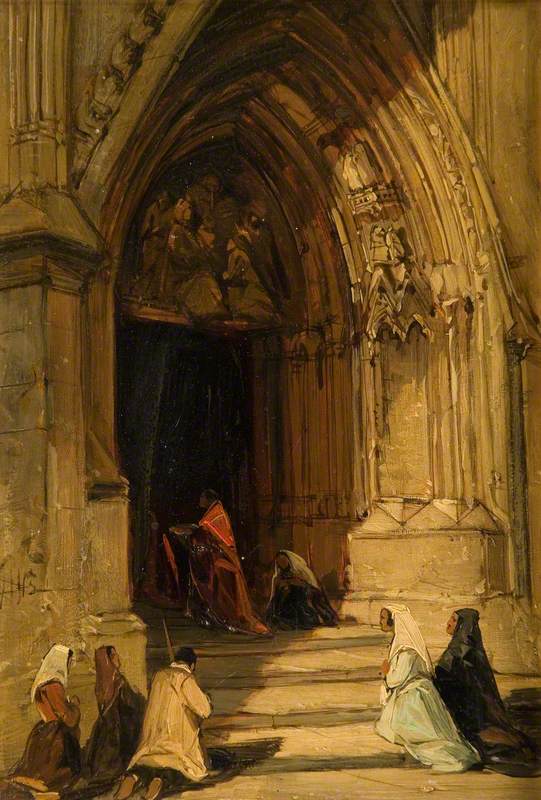
Painted in 1845, this depiction of the cathedral's northward door by artist James Holland (1799–1870) was created half a century afterward the cathedral had been desecrated during the French Revolution.
At the terminate of the eighteenth century, the newly formed revolutionary state turned hostile towards the Catholic church. Co-ordinate to sources, anti-monarchist forces mistook statues on the cathedral for kings of France, dragging the sculptures to the guillotine where they were beheaded in 1793.
In 1804 (later on the trigger-happy degradation of the monarchy), Emperor Napoleon I was coronated inside the historic landmark. The moment was painted by the Neoclassical painter Jacques Louis David (1748–1825).
In 1831, Victor Hugo (1802–1885) published the wildly popular Gothic novel, The Hunchback of Notre-Matriarch, which detailed the celebrated site's neglect after years of revolution. Describing information technology as a 'symphony in rock', Hugo turned French republic'south attention towards the building'south dilapidated status, leading to much-needed renovations betwixt 1844 to 1864.
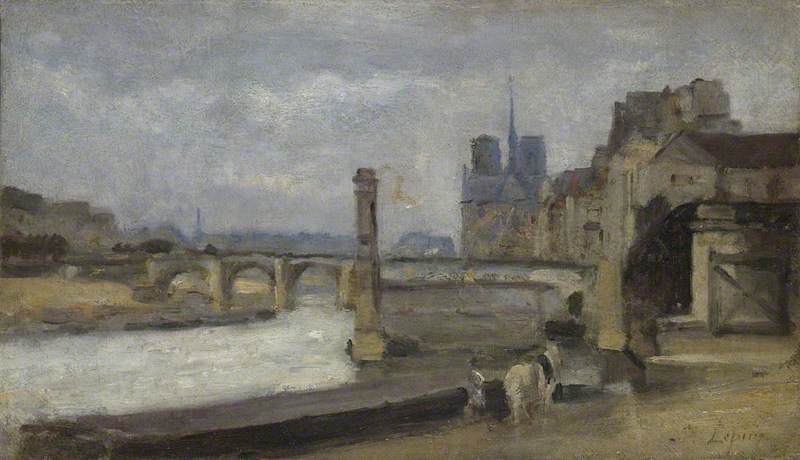
A French painter whose speciality was depicting the Seine, Stanislas Lépine (1835–1892), captured the apse of Notre Dame in this painting of the Pont de la Tournelle (Tournelle bridge) dated between 1862–1864.
By the 1860s, Emperor Napoleon III (the nephew of Napoleon I) had established the Second French Empire and commissioned Georges-Eugene Haussmann to commence on an ambitious and massive public works project that would renovate and reshape the urban construction of Paris.
Earlier the 'Haussmanisation' of Paris, the cathedral was surrounded by slums and housing condensed together on narrow, medieval streets. Napoleon ordered Haussmann to 'open' (or demolish) the surface area, so that Notre Dame could be viewed properly, thus creating the big public square that stands in front of the cathedral today.
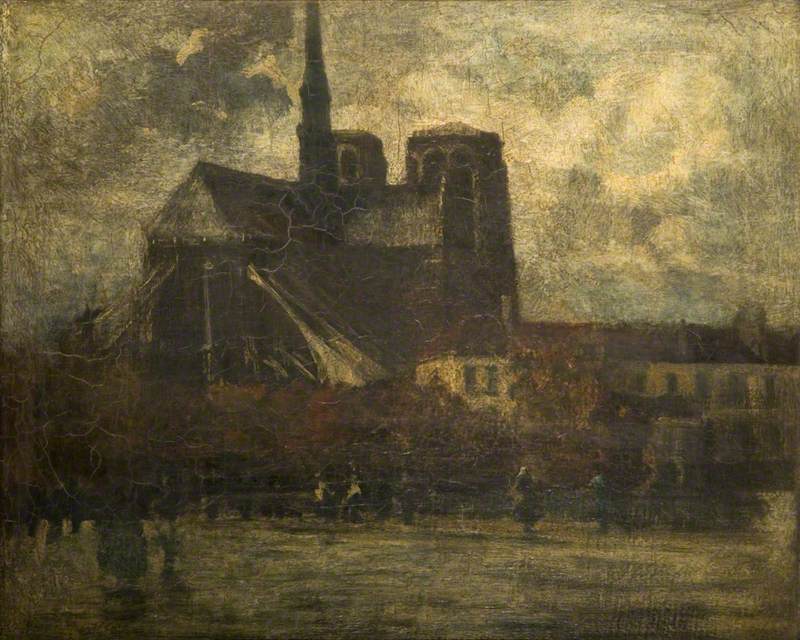
French painter Jules Lessore (1849–1892) depicted the cathedral some fourth dimension in the mid to late nineteenth century. Lessore emigrated to England in 1871 (during the Franco-Prussian war) and fathered Thérèse Lessore, a painter whose fame would eventually surpass her father's.
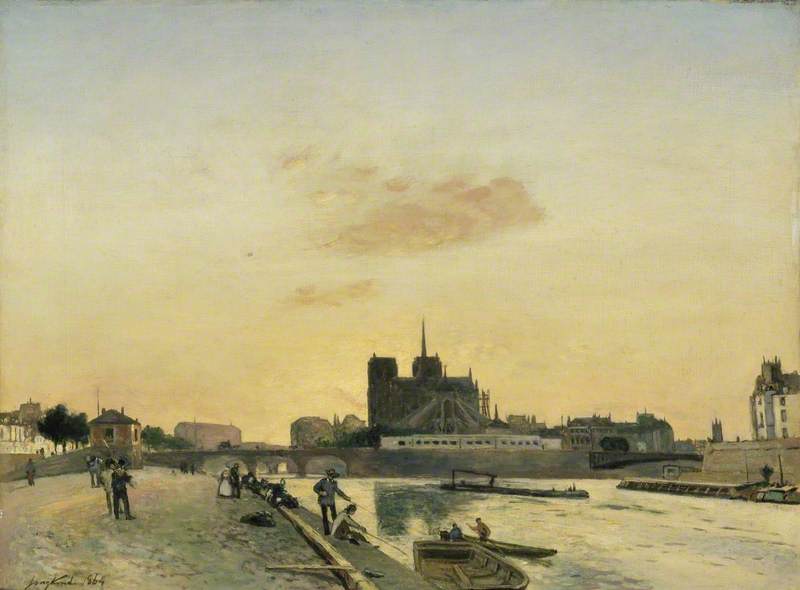
This painting by Dutch creative person Johan Barthold Jongkind (1819–1891) shows Notre Dame in the 1860s when the effects of Haussmanisation had cleared the area surrounding the cathedral. A precursor to Impressionism, Jongkind painted Notre Dame frequently, with i of his most famous depictions housed today in the Musée d'Orsay.
This painting, showing the effect of the setting sun over the cathedral, was painted for the Bordeaux collector, Théophile Bascle, in 1864.
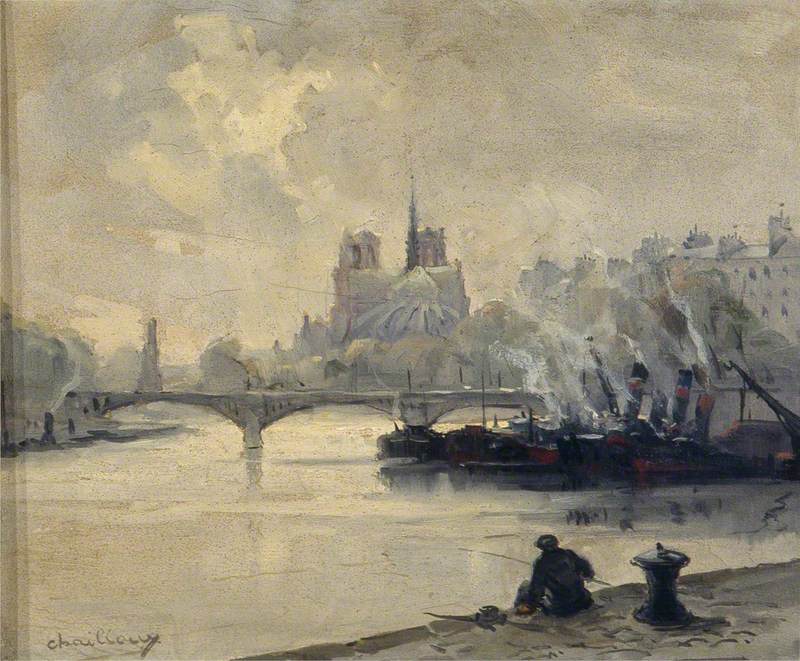
In 1905, Notre Dame officially became the holding of the French state rather than the Catholic Church in a movement towards the secularisation of France.
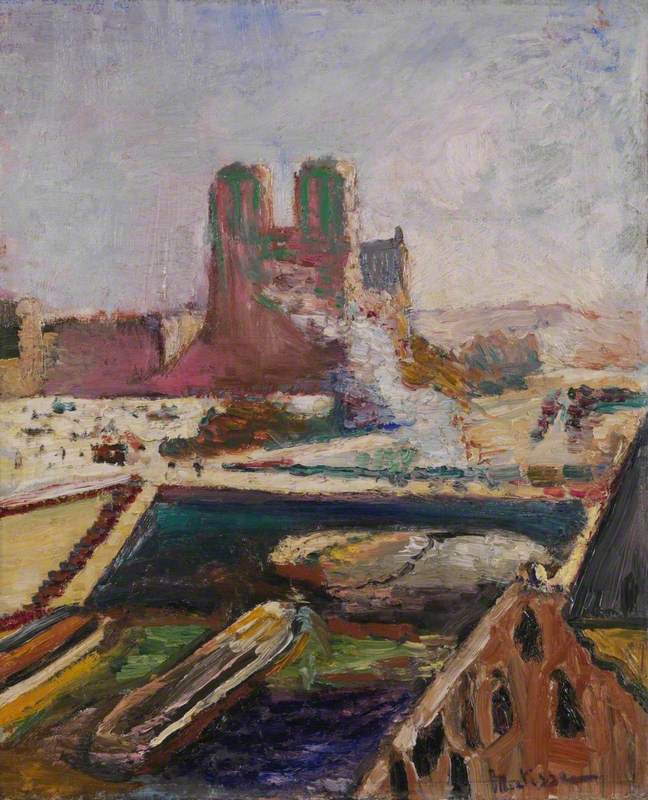
Henri Matisse (1869–1954) famously adored Notre Matriarch, which he could see from his studio located on the Quai Saint-Michel (he lived and worked there from 1899 until 1907).
His many depictions of the cathedral painted betwixt 1900 and 1914 testify the historic landmark at different times of the day, but also reveal his dramatic artistic evolvement into (what would subsequently be coined in 1905) as the 'Fauvist move'.
View of Notre Dame (1914) shows Matisse's radical difference from conventional practices of form and color and a move towards abstraction.
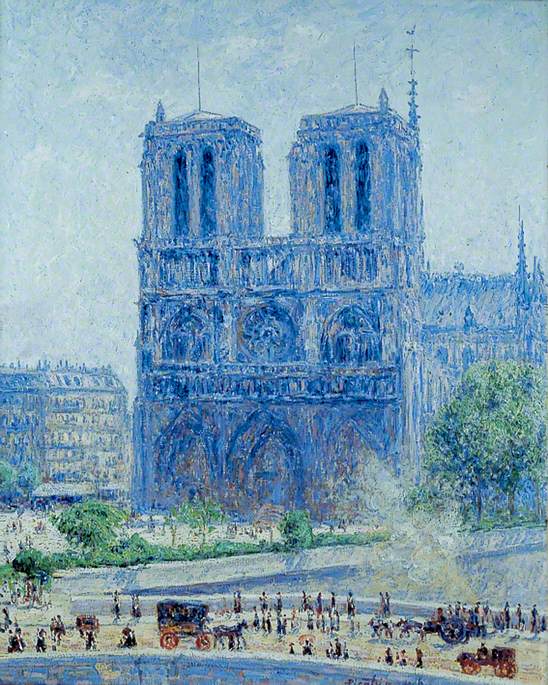
In 1906, avant-gardist Francis Picabia (1879–1953) painted Notre Matriarch in the Morning Sun. Like Matisse, Picabia was fixated with the cathedral, painting it multiple times at the beginning of the twentieth century – when he was still dabbling with Impressionism. His depictions of Notre Dame were well-nigh probable inspired by Claude Monet's (1840–1926) impressionistic paintings of Rouen Cathedral.
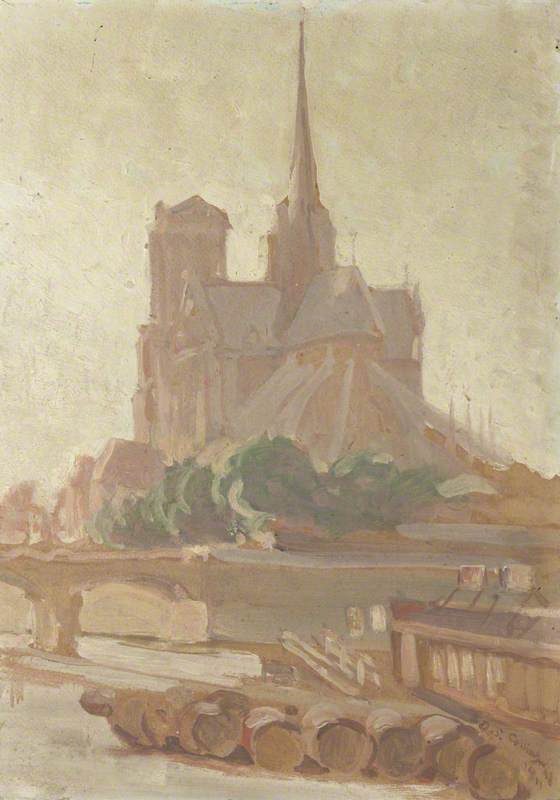
In 1911, shortly before the outset of the Kickoff World War, creative person Dora Altounyan (1886–1964) painted Notre Matriarch.
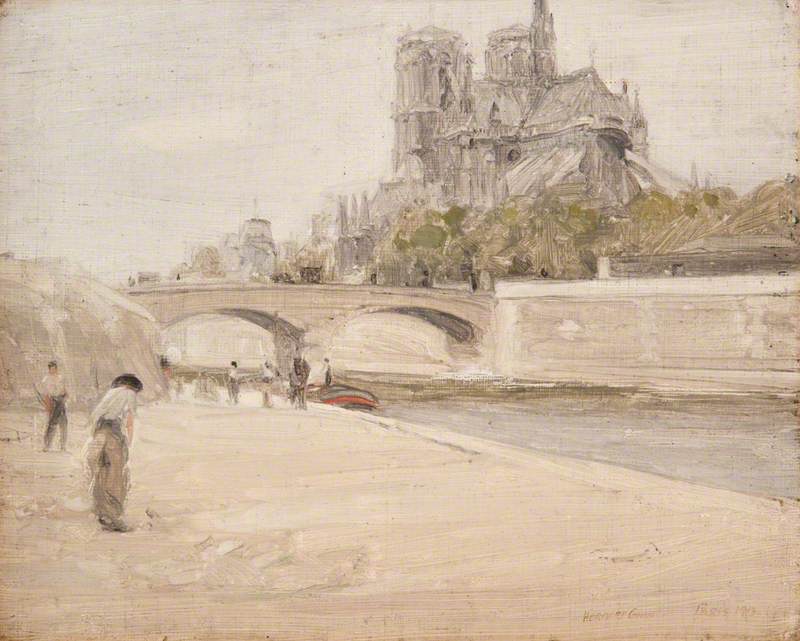
In 1913, the Scottish-British artist Herbert James Gunn (1893–1964) also painted the cathedral, and x years after Leonard Squirrell (1893–1979) would visit Paris to paint the Gothic landmark.
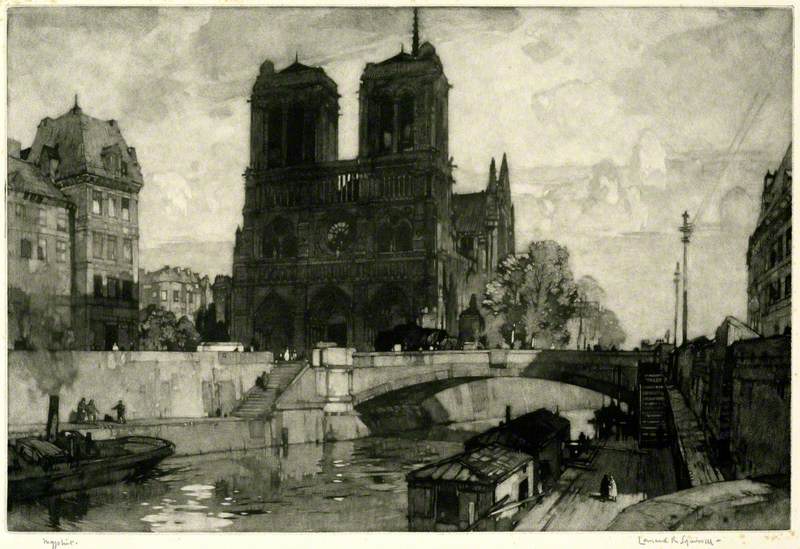
Notre Dame, Paris 1924
Leonard Squirrell (1893–1979)
Colchester and Ipswich Museums Service: Ipswich Borough Quango Collection
Notre Dame survived both the First and Second Earth Wars, announcing the liberation of Paris in 1944 when its bells rang out triumphantly.
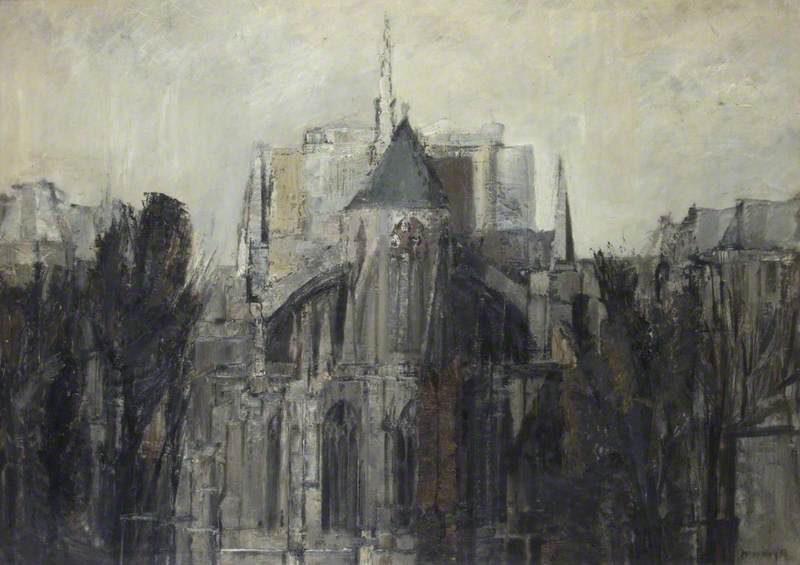
In the mail-war era, British artist Bernard Kay (b.1927) created this depiction.
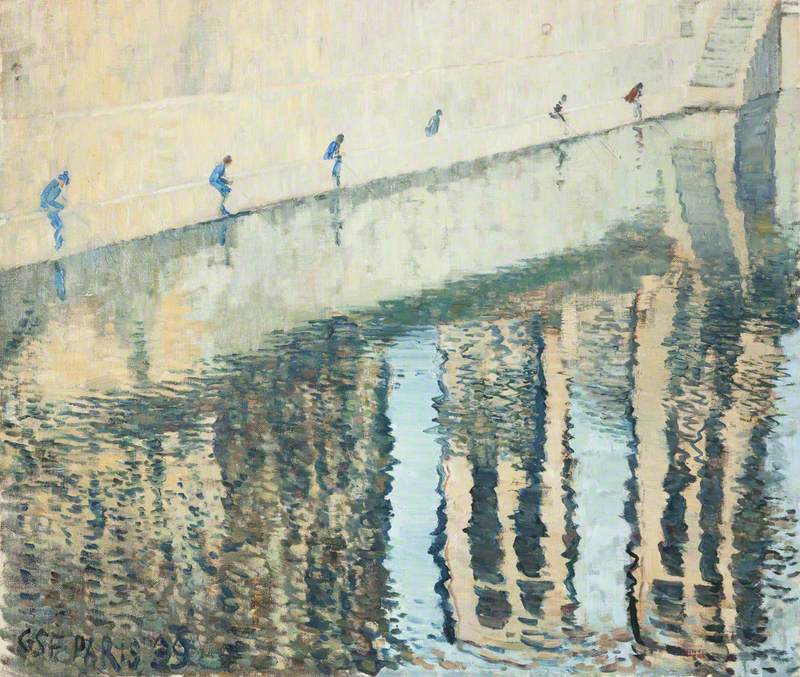
Finally, in 1999, Geoffrey Scowcroft Fletcher (1923–2004) painted Notre Dame, Reflections, showing the iconic n and south towers of the cathedral reflected in the waters of the Seine.
In the wake of the tragic fire that has demolished a large proportion of the Gothic cathedral's original roof – although we do non yet know the full extent of the damage or cause of the bonfire – information technology seems appropriate to reflect on the history of 1 of Europe'south most-loved historical landmarks.
Remarkably, Notre Dame cathedral withstood the test of time – miraculously enduring and surviving many conflicts, revolts and wars. It has also been restored, renovated and rebuilt many times over.
The argent lining to this catastrophe is that the new ambitious renovations volition ultimately boost its longevity while reminding united states of america to not take for granted what we take left of this cultural and historical treasure.
Lydia Figes, Fine art UK'south Content Creator
Did you know?
- It took approximately 200 years to build Notre Dame past roughly ane,000 workers during the reign of Louis VII. Construction began in 1163 lasting until 1345
- A fire broke out at the cathedral in the thirteenth century, prompting renovations of the site between 1230 and 1240
- In the sixteenth century, the Huguenots (French Protestants) desecrated statues they believed were idolatrous
- In 1793, during the French Revolution, anti-royalists decapitated statues within of the cathedral, mistaking Biblical kings for members of the French imperial family
- The famous gargoyles adorning the cathedral, featuring prominently in The Hunchback of Notre-Matriarch, were added during the nineteenth-century restoration
More stories
Artworks
Source: https://artuk.org/discover/stories/notre-dame-cathedral-inspiring-artists-for-centuries
0 Response to "What Popular Art Pieces Are in Notre Dame Cathedral"
Enregistrer un commentaire